In the fast-paced world of texting, social media, and online chats, words aren’t just words—they carry tone, intent, and sometimes even drama.
One word that pops up often but can confuse many people is “provoke.” Whether you’ve seen it in memes, social media posts,
or group chats, understanding what provoke means and how to use it correctly is essential to avoid misunderstandings.
In this guide, we’ll break down everything you need to know about provoke meaning, including its origin, how to use it in texts, real-life examples, common mistakes, and related slang.
By the end, you’ll be texting and chatting with confidence, knowing exactly when and how to use this word.
What Does “Provoke” Mean? Definition & Origin:
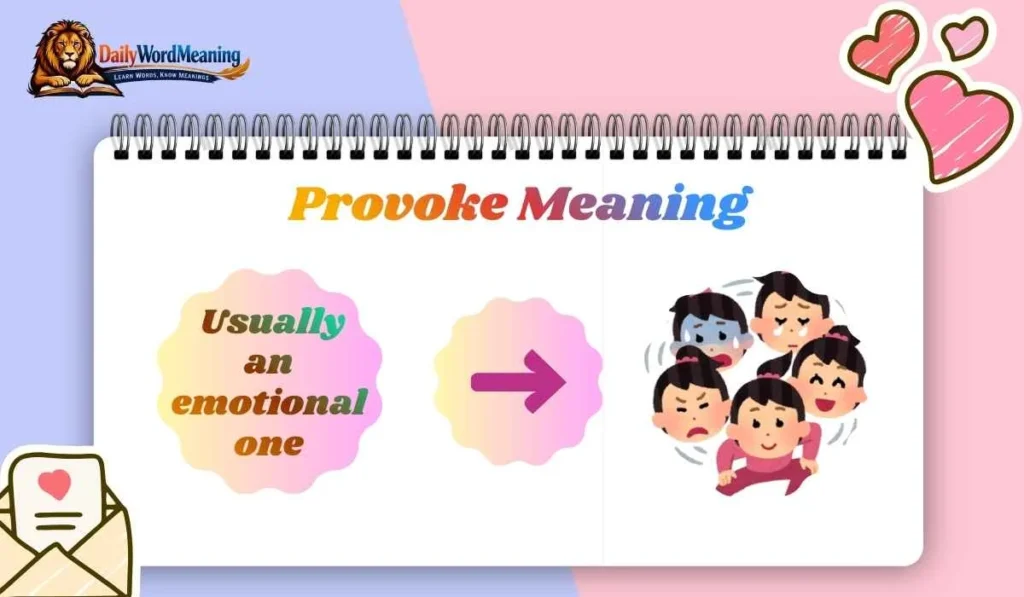
At its core, provoke is a verb that means to deliberately cause a reaction, usually an emotional one, in someone else.
- Formal definition: To stimulate or incite someone to feel a particular emotion or take action.
- Common everyday use: To annoy, anger, or challenge someone on purpose.
Origin:
The word provoke comes from the Latin word provocare, meaning “to call forth” or “challenge.” Over time, it evolved in English to mean instigating a reaction—sometimes playful, sometimes serious.
Quick Tip: In modern texting or social media slang, provoke can be used playfully (“stop provoking me 😂”) or seriously (“he provoked a lot of drama”).
How to Use “Provoke” in Texts or Chat
Understanding the provoke meaning in casual conversations is easier when you see it in action. Here are some common ways people use it in texting and online chats:
1. Playful Teasing
- “Stop provoking me with those memes 😆”
- “You know how to provoke me into replying instantly!”
Here, provoke is used lightly, showing that someone is teasing or joking.
2. Serious Arguments or Drama
- “He provoked her by spreading rumors online.”
- “Don’t provoke him, he’s already upset.”
In this context, provoke is more serious and implies that someone intentionally caused anger or conflict.
3. Social Media Engagement
- “This tweet is clearly meant to provoke reactions.”
- “The meme provoked hundreds of comments in just an hour!”
Here, the word is often used to describe posts, tweets, or content that is designed to stir discussion or emotion.
Pro Tip: Always consider tone—provoke can be lighthearted in memes but serious in arguments.
Examples of “Provoke” in Conversations
Let’s look at some relatable chat scenarios to see provoke meaning in action:
Scenario 1 – Group Chat Fun:
- Friend 1: “I’m not sending that picture 😅”
- Friend 2: “Oh come on, don’t provoke me!”
(Here, provoke = playful teasing.)
Scenario 2 – Drama Alert:
- Friend 1: “He keeps tagging her in posts to provoke her.”
- Friend 2: “Wow, that’s harsh 😬”
(Here, provoke = intentionally annoy or challenge.)
Scenario 3 – Social Media:
- User: “This post is clearly trying to provoke a debate about gaming culture.”
(Here, provoke = stimulate reactions online.)
Quick Note: Using provoke correctly can prevent misunderstandings, especially in text where tone isn’t obvious.
Common Mistakes or Misunderstandings
Even though provoke is widely used, it’s easy to misuse. Here are some pitfalls:
- Mistake 1: Confusing with “annoy”
- Annoy = small irritation
- Provoke = deliberate action to trigger a strong reaction
- Example: “Stop provoking me” can be stronger than “Stop annoying me.”
- Mistake 2: Using in the wrong context
- Wrong: “I provoked my sandwich 🍕”
- Correct: “He provoked a fight in the chat.”
- Mistake 3: Ignoring tone
- Texts lack tone, so a playful “don’t provoke me” could be read as serious.
- Solution: Use emojis or clarifying words for tone.
Related Slangs or Abbreviations
When discussing provoke meaning, it’s helpful to know related slang that often appears in chats:
- Triggered – Someone who is emotionally affected or provoked
- Troll – A person who provokes others online for reactions
- Shade – Subtle provocation, often in comments or DMs
- Salty – Someone reacting negatively after being provoked
Example Chat:
- “He’s so salty, don’t provoke him 😂”
- “That troll just loves to provoke people online.”
These words often appear alongside provoke in casual conversations and social media.
Practical Tips for Using “Provoke” Correctly
Here’s how to master provoke meaning in your texts and chats:
- Know your tone: Add emojis or punctuation to show if you’re joking or serious.
- Context matters: Use provoke for intentional actions, not accidental annoyances.
- Observe reactions: If your friend seems upset, don’t push further.
- Pair with slang for modern chats: Words like “triggered” or “salty” make it sound natural online.
Quick Example:
- “Haha stop provoking me 😜” – playful
- “Please don’t provoke the argument further” – serious
Conclusion:
Understanding provoke meaning is more than just knowing a dictionary definition—it’s about reading tone, context, and intent in modern texting culture.
From playful teasing with friends to serious online debates, the word is versatile but powerful.

I am Zaho Lusi, and I am a meaning author.
I write simple, clear, and easy-to-understand meanings to help readers learn new words without confusion. My main focus is making language simple so that everyone—students, beginners, and curious learners—can understand words quickly and easily.