Updated 2026 – If you’ve ever poured honey, oil, or even shaken up a soda, you’ve experienced viscosity in action.
But what does this word really mean? Understanding viscosity isn’t just for science students—it’s useful in everyday life, from cooking to car maintenance, even in skincare. In this article,
we’ll break down the viscosity meaning, show how it’s used in real-life contexts, and share tips for understanding related terms.
What Does “Viscosity” Mean? Definition & Origin:
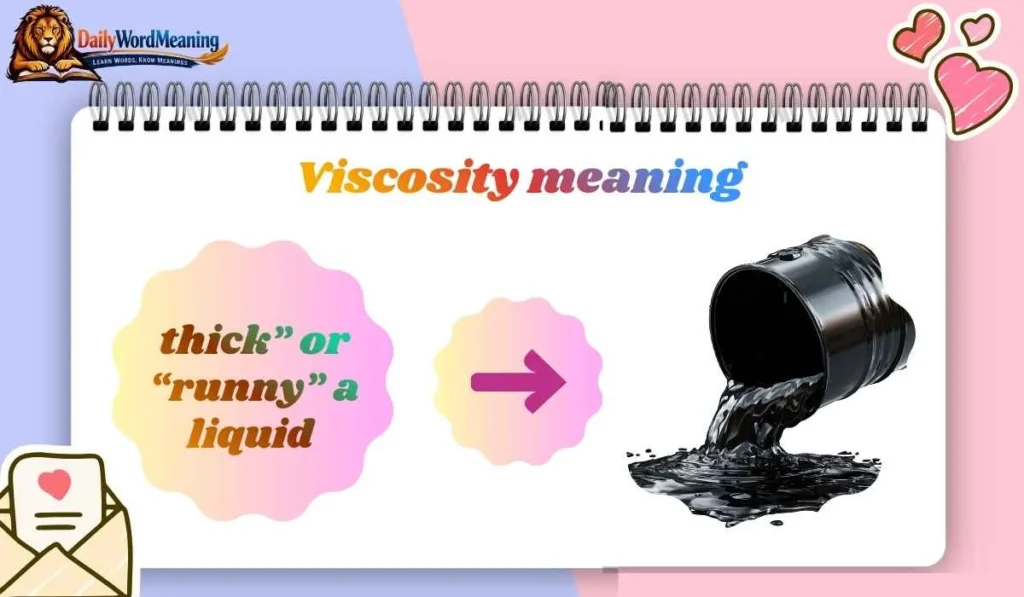
At its core, viscosity is a measure of a fluid’s resistance to flow. Simply put, it tells you how “thick” or “runny” a liquid is.
- High viscosity: Think honey or molasses. These liquids flow slowly.
- Low viscosity: Think water or juice. These liquids flow quickly.
Origin of the Word
The term comes from the Latin word viscum, which means “sticky.” Over time, it became part of the scientific vocabulary to describe fluid dynamics and material properties.
💡 Pro Tip: Next time someone calls your smoothie “too thick,” you can technically blame its high viscosity!
How to Use “Viscosity” in Texts or Chat
While viscosity is mostly a science term, it occasionally pops up in informal conversations, especially among students, gamers, or anyone joking about liquids. Here’s how you might see it used:
- Text Example 1: “This smoothie has way too much viscosity 😅, can’t sip it!”
- Text Example 2: “The new game physics is weird… low viscosity makes water feel like oil.”
- Text Example 3 (Funny Meme Context): “Me trying to move out of bed Monday morning: high viscosity mode activated.”
In online forums or group chats, viscosity can also be used metaphorically, like describing slow processes or sticky situations.
Examples of “Viscosity” in Conversations
To make it crystal clear, here are some realistic examples:

- Science Class Chat:
- Alex: “Why does syrup flow slower than water?”
- Jamie: “It’s because syrup has higher viscosity. Makes sense, right?”
- Cooking Group Chat:
- Sam: “The sauce is too runny.”
- Mia: “Add cornstarch to increase the viscosity.”
- Gaming Forum:
- Player1: “The water physics feels weird.”
- Player2: “Yeah, they lowered the viscosity, now it’s more like a smoothie than a river.”
Notice how these examples show the term used in practical, everyday scenarios, not just textbooks.
Common Mistakes or Misunderstandings
Even though viscosity is simple in concept, it’s often misused or misunderstood.
- Viscosity ≠ Density
- Density measures how heavy a liquid is for its volume.
- Viscosity measures how easily it flows.
- Example: Honey is high viscosity but not as dense as lead.
- Thick ≠ High Viscosity Always
- Some liquids feel thick but are actually low in viscosity under certain conditions (like ketchup under shaking).
- Temperature Effects
- Hot liquids often have lower viscosity than cold ones. Example: Warm honey flows easier than cold honey.
💡 Quick Tip: If someone uses “viscosity” just to mean “sticky,” clarify they might be mixing it up with tackiness.
Related Slangs or Abbreviations
While viscosity itself isn’t a chat abbreviation, you might encounter it in online science discussions or meme culture. Related terms include:
- Shear-thinning: When a liquid’s viscosity decreases under stress (like ketchup).
- Shear-thickening: When a liquid becomes thicker under stress (like cornstarch in water).
- Flow rate: How fast a liquid moves, closely related to viscosity.
For a fun twist in texting: you might even see “visc-y” jokingly used among friends to describe something “thick or sticky” in life situations.
Why Knowing Viscosity Matters
Understanding viscosity isn’t just academic—it’s practical:
- Cooking & Baking: Adjust sauces, syrups, or batters for perfect texture.
- Automotive: Engine oil viscosity affects car performance.
- Skincare & Cosmetics: Creams and lotions use viscosity to control absorption.
- Gaming & Simulations: Realistic fluid dynamics make games feel more immersive.
💡 Pro Tip: Next time someone says, “This smoothie has weird viscosity,” you’ll sound like a science pro.
Conclusion:
Viscosity meaning is more than a textbook term—it’s a concept we interact with every day, whether in the kitchen, at the gas station, or scrolling memes online.
By understanding viscosity, you can better describe liquids, improve practical tasks, and even join conversations where the term pops up in science, tech, or gaming contets.

I am Zaho Lusi, and I am a meaning author.
I write simple, clear, and easy-to-understand meanings to help readers learn new words without confusion. My main focus is making language simple so that everyone—students, beginners, and curious learners—can understand words quickly and easily.